

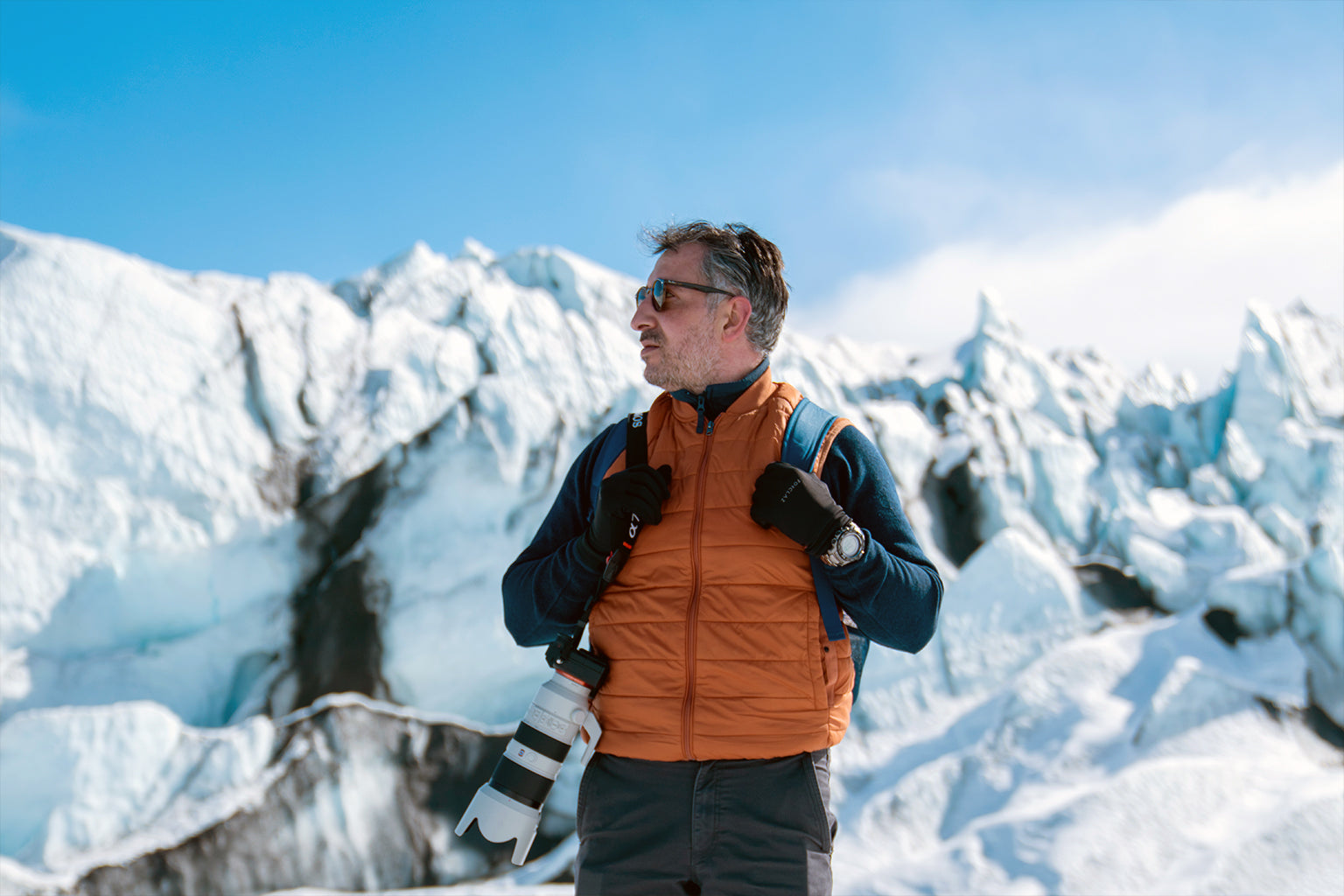
By Hasan Akbas · Landscape Photographer & Alaska Tour Host
I have stood on the Matanuska Glacier more times than I can count. And I want to tell you something that every tour description gets wrong: photographs don’t prepare you for it. Not mine, not anyone’s.
The first time you step off the gravel moraine and onto the ice itself — blue ice that formed when the pyramids were being built — something shifts in how you understand the word old. You’re not looking at something ancient. You’re standing on it. It is underneath your boots, moving imperceptibly, alive in a geological sense that no photograph can transmit.
This is Day 2 of the Alaska Northern Lights Tour. And for many guests, it becomes the day they talk about longest.
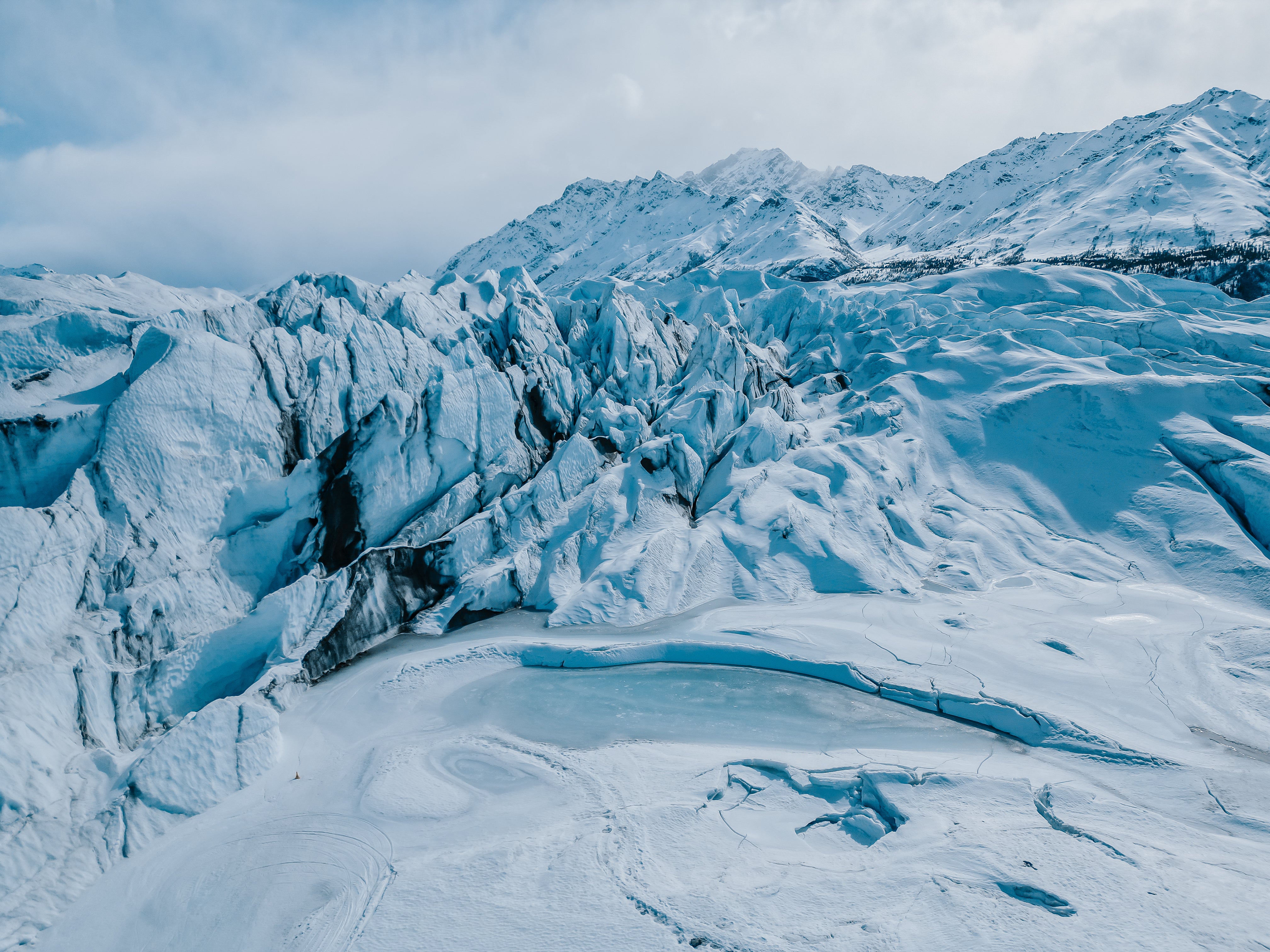
Matanuska Glacier from above — drone photograph © Hasan Akbas
Where Is the Matanuska Glacier?
The Matanuska Glacier sits in the Matanuska Valley in South-Central Alaska, roughly two hours northeast of Anchorage along the Glenn Highway — one of the most scenic drives in North America. At 27 miles long and four miles wide, it is the largest glacier in Alaska accessible by road. No boat, no helicopter, no floatplane required. You drive through the Chugach Mountains, turn off the highway, and there it is: a river of ancient ice pouring out of the Alaska Range.
From Anchorage, the drive itself is worth the trip. The Glenn Highway climbs through birch forests and opens onto valleys where the mountains crowd in on both sides. In fall, the hillsides burn amber and red. In winter, everything is white and still. In spring, the ice melt carves new channels through the gravel plain below the glacier.
What Does Walking on a Glacier Actually Feel Like?
Before you step onto the ice, you put on crampons — metal spikes that attach to your boots and grip the glacier surface. Once you’re on the ice, everything changes.
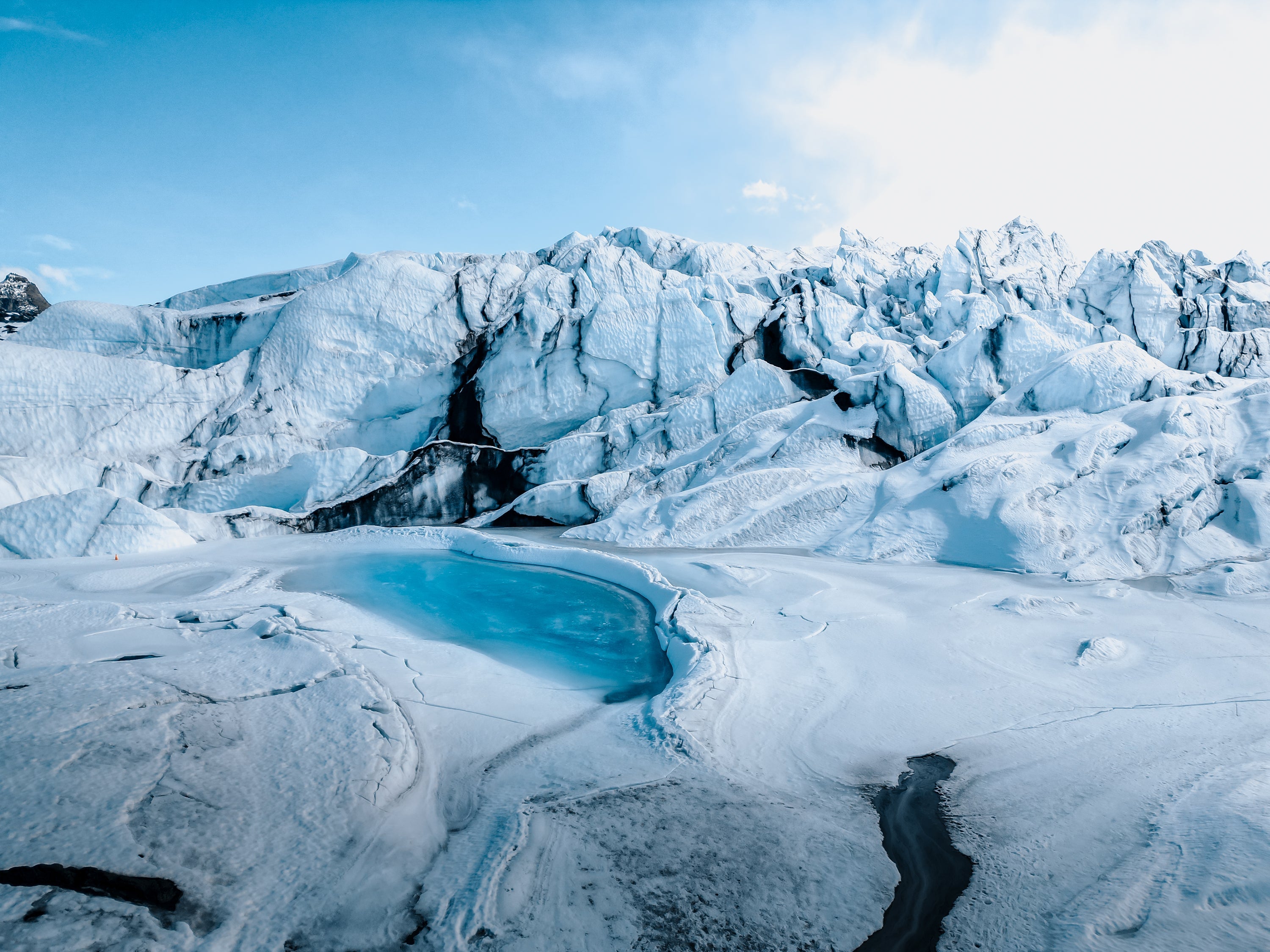
The first thing you notice is the color. Glacier ice isn’t white. Up close, where you’re walking through a crevasse or past a meltwater pool, the ice is a deep, saturated blue — the color you see at the bottom of a very clear ocean. This is because glacial ice is so compressed that it absorbs red wavelengths of light and reflects blue. You can read that in a textbook. Standing inside it is a different experience.
The second thing you notice is the sound. Glaciers are not silent. You hear water running somewhere beneath you, meltwater channels that appear and disappear seasonally. Occasionally, in the distance, something shifts. The glacier is moving — advancing and retreating over decades — and it makes noise about it.
The third thing is the scale. Looking up from the surface of the Matanuska, the ice walls rise around you. You can see the striations in the ice, the layers of compression, the debris carried down from the Alaska Range over centuries. You are inside geology.
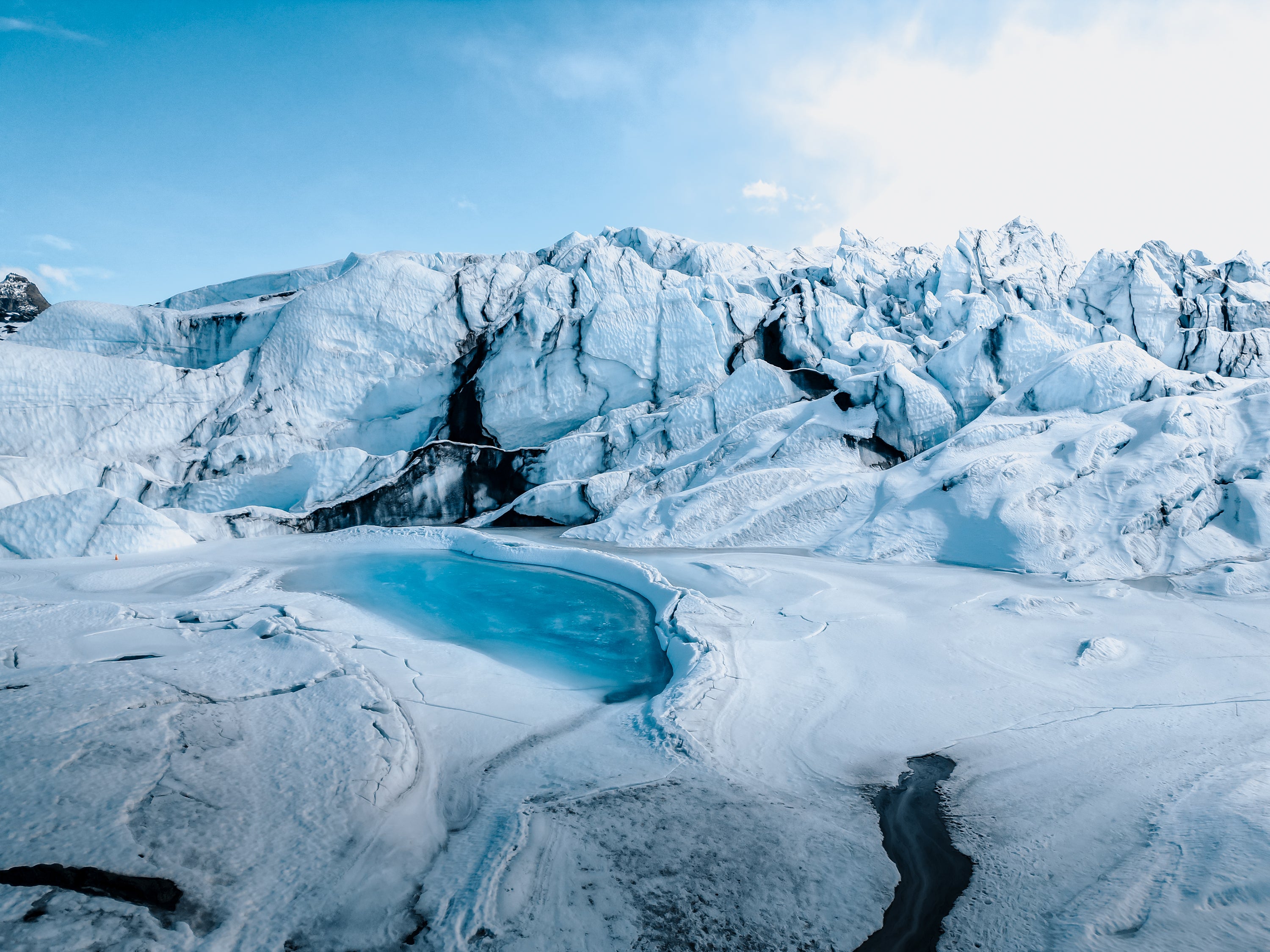
Matanuska Valley panorama — Palmer, Alaska © Hasan Akbas
Best Time to Visit Matanuska Glacier
Fall (September – November) is my personal favorite window. The valley colors are at their peak — the birch and aspen forests along the Glenn Highway turn gold and orange, and the contrast against the blue-grey ice is extraordinary for photography. This is also the beginning of aurora season, which means you can combine a glacier walk in the afternoon with an aurora chase the same evening. That combination is the heart of Day 2 on the tour.
Winter (December – April) transforms the glacier entirely. The surrounding landscape is buried in snow. The ice takes on a different quality — harder, more dramatic, the crevasses sharper. Dog sledding is available in this window, which means winter guests have a morning of full-speed mushing through snow-covered valleys followed by an afternoon on ancient ice.
Summer brings the most visitors and warmer temperatures on the ice. If your primary goal is the glacier itself, summer works well. But if you’re combining the glacier with aurora viewing, fall or winter is the right choice — you need darkness for the lights.
Matanuska Glacier as Part of the Alaska Northern Lights Tour
On Day 2 of the tour, we leave Anchorage in the morning. In winter, we stop first at an Iditarod-heritage dog sledding kennel in the Wasilla area. In fall, we visit a Reindeer Farm among the Chugach foothills before turning northeast on the Glenn Highway.
At the glacier, we walk for two to three hours depending on conditions. Crampons and all access fees are fully included — there’s nothing to add or pay separately. We explore the glacier surface, find the meltwater channels, photograph the ice formations. I bring the same eye I bring to my professional work: I’m looking for the angle that shows the scale, the color, the age of the place.
By late afternoon, we’re back in the van heading toward Hatcher Pass for the evening’s aurora positioning. Two glaciers, one aurora — that is what Day 2 looks like.
Matanuska Glacier, Alaska · Hasan Akbas
Practical Information
What to wear: Waterproof boots with ankle support are essential. In winter, add insulated layers — temperatures on the glacier can be significantly colder than in Anchorage. In summer, bring sunglasses and sunscreen; the UV reflection off white ice is intense.
Photography: A wide-angle lens captures the scale. A polarizing filter cuts the reflection from meltwater pools and reveals the true blue of the ice. On cloudy days, the glacier shows its best color — diffused light removes harsh shadows from the crevasses and makes the blue ice glow.
Physical requirements: The glacier walk involves uneven terrain and requires attention with every step. Most people of average fitness manage the standard tour without difficulty. The crampons do most of the work. Children from about age eight upward are generally comfortable.
Alaska Northern Lights Tour
The Matanuska Glacier is fully included in the tour — crampons, access fees, and transportation from Anchorage. Maximum six guests per departure.
View Tour & Departure Dates →

