

After more than 100 nights chasing the aurora across Alaska, I've spent an extraordinary amount of time standing in the dark in places where wildlife is abundant. The question I get asked most often — besides camera settings — is this: do animals react to the northern lights?
The scientific answer is incomplete. Research on animal responses to aurora is limited, largely anecdotal, and complicated by the fact that aurora tends to appear during the same cold, dark conditions that affect animal behavior for entirely unrelated reasons. But direct observation over hundreds of hours gives you something science papers can't always capture: patterns.
Here's what I've actually witnessed.
Sled Dogs — The Most Dramatic Response I've Seen
I'll start here because this is the observation that surprised me most, and the one I've now witnessed multiple times at Happy Trails Kennel in Big Lake.
Sled dogs are extraordinarily attuned to their environment — bred and trained for thousands of years to operate in Arctic conditions, reading weather, terrain, and sky with a sensitivity that's genuinely humbling to observe up close. On strong aurora nights, their behavior changes.
The most memorable instance was a night in October when a KP 6 display lit up the entire sky above the Mat-Su Valley. The aurora wasn't just a band on the horizon — it was overhead, curtains of green and violet shifting rapidly across the full dome of the sky. The kennel, which had been quiet, became suddenly alive. Dogs that had been sleeping stood up. Some began the low, rhythmic howl that sled dogs produce differently from domestic dogs — almost musical, sustained. Others simply faced the sky.
Was it the aurora specifically? Or the sudden increase in ambient light? Or infrasound from geomagnetic activity that humans can't detect? I don't know. What I know is that the timing was precise — the behavior started as the aurora intensified and faded as it weakened. Martin Buser, who has lived and worked with these dogs for decades, confirmed he's observed it regularly.
Whatever the mechanism, watching a kennel of Iditarod dogs respond to a full-sky aurora is one of the most remarkable wildlife experiences I've had in Alaska.
Moose — Largely Indifferent, With Exceptions
Moose are Alaska's most commonly encountered large mammal in the Anchorage region, and I've observed them on dozens of aurora nights. My general conclusion: moose are largely indifferent to the northern lights.
I've watched moose graze at the edge of frozen ponds while the sky turned green above them — ears rotating to track sounds, eyes occasionally scanning the treeline, completely uninterested in the light show overhead. The aurora doesn't appear to register as a threat or a stimulus worth responding to.
The exception I've observed: very rapid, bright aurora activity — the kind where the sky flashes or shifts dramatically in seconds — can produce a brief alerting response. The animal's head comes up, ears forward, scanning. Then, finding no ground-level threat, they return to what they were doing. The response seems to be to the sudden light change rather than to the aurora itself.
What affects moose behavior far more than aurora: the sound of a vehicle door closing, human scent on the wind, or the crunch of boots on frozen snow. On aurora nights, staying quiet and downwind matters infinitely more than what the sky is doing.
Bald Eagles — Roosting, Not Responding
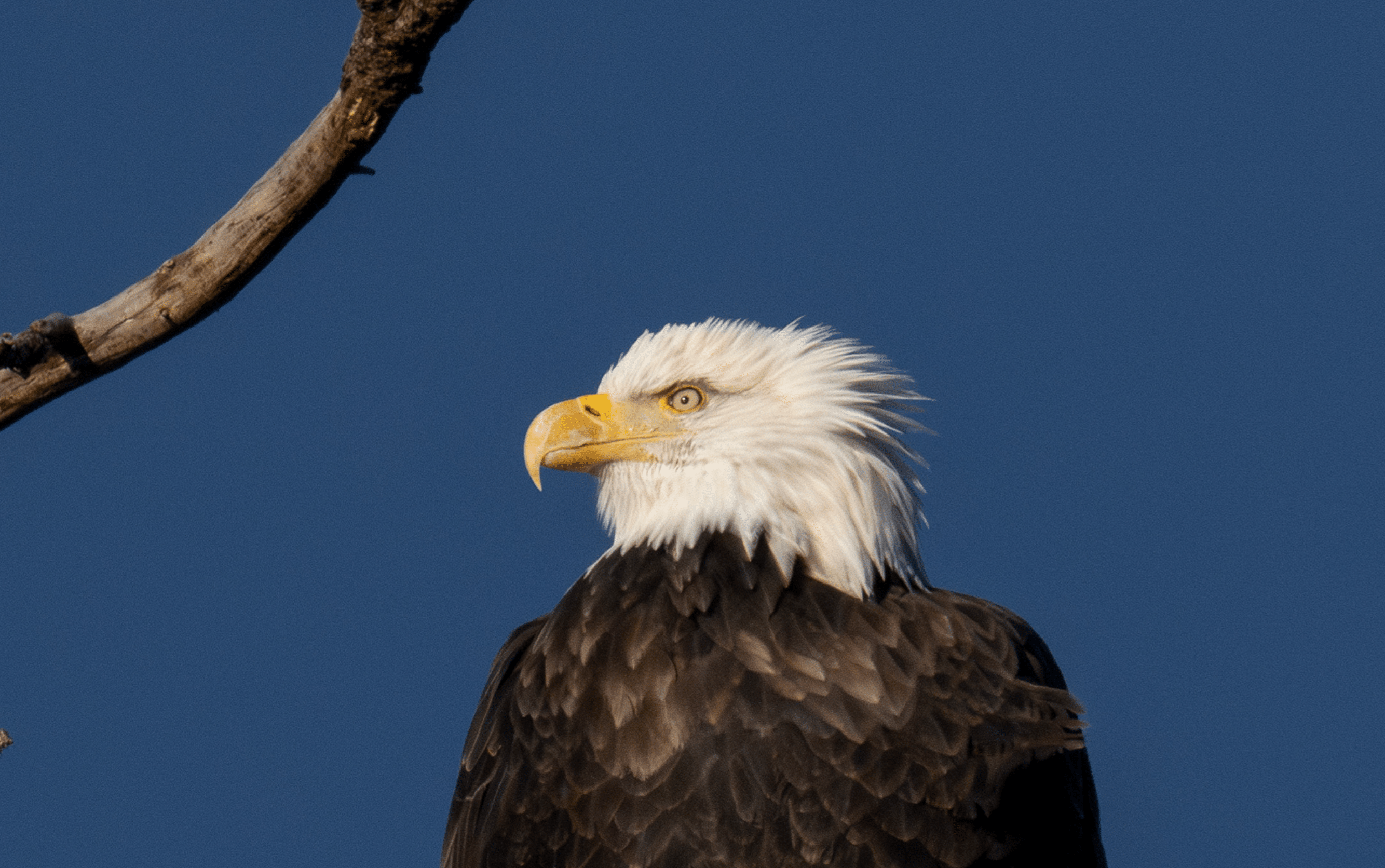
Eagles are diurnal — active during daylight, roosting at night. By the time aurora appears, any eagle you encounter is perched and largely inactive. I've photographed eagles roosted in spruce trees along Turnagain Arm on nights with strong aurora overhead, and they showed no observable response to the light.
What's worth knowing: bald eagles in Southcentral Alaska congregate in remarkable numbers along certain river systems in late autumn and winter, following the late salmon runs. If your aurora chase takes you along the right river corridor at the right time of year, you may find yourself surrounded by roosting eagles — a surreal experience in headlamp light. The aurora above, eagles in the trees, the river below. Alaska delivers combinations like this.
Caribou — The Indigenous Perspective
I haven't personally observed caribou on aurora nights — their primary range in Southcentral Alaska is higher elevation and more remote than my typical aurora locations. But it's worth including what Alaska Native oral traditions say about this, because these are observations accumulated over thousands of years of living with both caribou and aurora.
Several Alaska Native traditions describe caribou as being aware of and responsive to the northern lights — in some accounts, the aurora is described as the spirits of animals dancing. Whether or not you interpret this literally, the observation that caribou behavior changes under active aurora conditions is consistent across multiple independent indigenous traditions. That pattern of observation deserves respect.
Wolves — One Encounter Worth Sharing
This happened once, and I'm including it because it was extraordinary.
On a January night north of Palmer, during a moderate aurora display over the Talkeetna Mountains, I heard howling from the treeline approximately 400 meters from where I was shooting. It lasted several minutes — a full pack chorus, the kind that makes your spine register something ancient. Then silence.
I have no idea whether the wolves were responding to the aurora, to our vehicle, to something else entirely. But the timing — the howling beginning as the aurora intensified and stopping as it quieted — was striking enough that I've thought about it many times since. Alaska has a way of giving you experiences that resist clean explanation.
What Science Currently Suggests
The honest answer is that research on animal responses to aurora is limited. A few studies have examined reindeer (closely related to caribou) in Scandinavia and found some behavioral changes under strong geomagnetic conditions — changes in grazing patterns, movement, and alertness. The proposed mechanism is magnetic field sensitivity: many animals, including birds, fish, and some mammals, have demonstrated sensitivity to magnetic fields, and strong geomagnetic events (which produce aurora) could plausibly affect animals with this sensitivity.
There's also the infrasound hypothesis: strong auroral events produce infrasound — extremely low-frequency sound waves below human hearing — that some animals may detect. Dogs, in particular, have hearing ranges significantly different from humans and may perceive aspects of aurora events that we cannot.
The honest position is: we don't fully know. The observations are real. The mechanism is uncertain.
What You'll Actually See on an Aurora Night in Alaska
Here's the practical reality for anyone planning an aurora trip: Alaska's wildlife doesn't organize itself around your aurora schedule, and the most memorable wildlife encounters tend to happen in transit — on the drive to or from a chase location — rather than at the location itself.
Moose at the roadside at 11pm. A great horned owl on a fence post. The eyes of a fox catching your headlights at a pullout. These moments happen regularly on night drives through the Matanuska Valley or along the Seward Highway.
On my Alaska Northern Lights Tour, I photograph guests and wildlife with equal attention. The sled dogs at Happy Trails Kennel are a structured part of Day 2 — a genuine encounter, not a passing glimpse. The wildlife you encounter on aurora nights is part of what makes the Southcentral Alaska experience unlike anywhere else on Earth.
The sky performs. The animals go about their business. And occasionally, the two align in ways that are genuinely hard to explain.
— Hasan Akbas, Aurora Photographer · Anchorage, Alaska
Alaska Northern Lights Tour
Stop researching. Start chasing.
4 days. 3 consecutive aurora nights. Matanuska Glacier, dog sledding, and a National Geographic photographer who knows exactly where to position you — and when.
View the Alaska Northern Lights Tour →Starting from $4,999 · Maximum 6 guests · Fall 2026 & Winter 2027


